Hongdu focuses on the innovative research of global cleansing technology and materials, and is a comprehensive raw material service provider integrating R&D, production and sales; Founded in 2004, it has set up technology innovation and research centers in Shanghai and Guangzhou, and has three production bases of Hongmao, Hongsheng and Hongfeng, and is a national science and technology-based small and medium-sized enterprise and high-tech enterprise.
The company pays attention to research and development, with doctors of cleaning technology and tribology as the scientific research leader, with 23 professional R&D personnel, 7 R&D personnel with master's degree or above; It has established technical cooperation with Shanghai Institute of Technology, Sun Yat-sen University and other universities and institutions, and continues to lead the development of cleansing technology.
Professional services (technical confidentiality)
Supporting services
Value added services


Excellent gentleness and good skin sensation.
No salinization, easy to thicken


Strict selection, mild surface activity, refined development,
Suitable for low stimulation products


A:Several grades under one INCI name is a deliberate choice on our side, for two reasons. First, it protects your formula: the technical details differ between grades, so a finished product is harder to copy once it is on the market. Second, each grade is built for a different system — picking the wrong one shows up as problems with paste body, clarity or heat stability.
Take potassium cocoyl glycinate (KCB series). At the same dosage all of them form a paste, but the body differs:
· KCB-95T: white, on the translucent side — for cleansers where clarity matters
· KCB-95P: softer body — for mildly acidic systems
· KCB-95F: whiter, brighter and firmer — for paste-type products
The right way to choose is not to ask us to pick one for you. Tell us the dosage form, the skin feel you are targeting, the pH range and your cost band; our technical service will shortlist 2–3 candidate grades against 100+ own-developed ingredients and 1000+ formula references, and you confirm with samples.
A:The four forms are a trade-off between active content and process feasibility, not a ranking of quality:
· Powder: KCB-95T/95F/95P, SCB-95A, SCG-95, SLG-95 — high active content, lower cost per unit, smaller storage and freight volume; usually needs heat to dissolve and disperse, suited to cream and paste cleansers
· Granule: SCG-9508, CMT-90, A85, MS75G — good flow, no dust when charging, suited to plants with clean rooms and automatic weighing
· Paste: MS50 / MD50M, CMT-35, LT40 — balances active content with handling convenience; sulfosuccinate types are mostly paste and are common in mildly acidic formulas
· Liquid: GCK-30 series, GCS series, CMT-30 series — can be cold processed directly, saving heating energy; suited to cleansing mousse, liquid cleanser and shampoo
Suggested order of decision: first whether your line can heat and dissolve, then cost, then skin feel.
A:"Salt-free" means the system contains no chloride, not that it contains no sodium salt. Conventional amino acid surfactant production carries chloride ions into the ingredient, which is unfriendly to two kinds of formula: transparent systems that must stay clear and must not grain over time, and systems that are electrolyte-sensitive or where the customer has an internal limit on chloride.
Grades we offer on this line:
· GCK-30H: chloride-free, solvent-free, preservative-free, easy to thicken, rich and fine foam
· CMT-30K: no salt content, good compatibility, suited to transparent products
· SG-40GR: chloride-free, natural origin, fine and abundant foam
If you are making an ordinary cream cleanser with no special requirement on chloride, there is no need to go out of your way to pick a salt-free grade — it solves a specific problem, it is not simply "better".
A:Yes, and this is the core idea behind our fifth-generation cleansing technology (amino-acid/soap hybrid, 2017). Pure soap gives abundant foam and a fresh after-feel but tends to leave skin tight; pure amino acid is mild but is not competitive on foam or cost. A hybrid takes the strengths of both.
Ready-made hybrid ingredients mean you do not have to build the blend yourself:
· KCB-65F: potassium cocoyl glycinate + potassium stearate — rich fine foam, easy to thicken and to bring to a paste, preservative-free; for stable amino acid cleansers
· S-A95: palmitoyl glycine + myristic acid + stearic acid + sodium C14-17 sec-alkyl sulfonate — keeps the abundant foam of fatty acid with the conditioning feel of amino acid
· ST-35: sodium cocoyl alaninate + cocamidopropyl hydroxysultaine + sodium lauroamphoacetate + potassium cocoyl hydrolyzed oat protein — a four-component blend
How to trade off: for skin feel look at the fatty acid ratio, for mildness look at the share of amino acid surfactant, for cost look at total active matter. The actual ratio needs a side-by-side sample trial on your target product.
A:Listed by category, these are the options that can directly replace conventional petrochemical-origin materials (for the exact natural origin index, refer to each product's documentation):
· Primary surfactants: APG0810 (caprylyl/capryl glucoside), APG1214 (coco-glucoside), PO30 series (potassium olivate), SG-40GR (green synthesis, chloride-free)
· Functional surfactants: CR-30H (sodium cocoyl arginate), CRT-30 (sodium cocoyl arginate + sodium lauroyl taurate); the product page states 100% natural origin — please request the product documentation for the calculation basis
· Makeup removal: MP90 (EWG green-rated), RP-80F (EO-free, natural origin, suitable for eye-area use)
· Scrubs: SUGAR-301/311/313 (sucrose), HONDU SS (sea salt), DSS (Dead Sea salt)
· Botanical specialties: LB-20 (Phyllostachys edulis leaf extract, low-temperature extraction with natural spring water, no organic solvent)
One caution: natural origin does not equal mild, and does not automatically mean suitable for sensitive skin. An irritation assessment on the actual system is still required.
A:This line uses traceable domestic plant and mineral sources, built around a Chinese-origin story plus functional botanicals. It suits local brand narratives, ingredient-led content, and products that need a differentiated "Chinese ingredient". The 9 current grades group by direction:
· Oil control and moisture: LB-20 Phyllostachys edulis leaf extract (low-temperature spring-water extraction, no organic solvent, contains flavonoids and silicic acid), LC-70 Camellia oleifera seed extract
· Scalp and hair care: CQSEED EX quinoa seed extract, NPP EX bamboo shoot skin extract, POSEED EX Platycladus orientalis seed extract
· Moisture and soothing: CAT100 Citrus aurantium dulcis fruit water (endogenous hydration direction)
· Mineral and cleansing: CANAS Canadian bentonite + sea silt, ML-1 low-molecular spring water (half-width 40–55 Hz, third-party tested)
Scope note: everything above describes the composition and technical characteristics of the ingredient itself. Whether a finished product claims oil control, moisturising or scalp care is a decision the brand owner must make after completing efficacy evaluation and filing under the Cosmetics Supervision and Administration Regulation. We do not make those claims on your behalf.
A:Diagnose the problem first, then choose. We have 9 grades on this line, each mapped to a different situation:
· Hard to thicken amino acid / alkyl phosphate / sodium isethionate systems: HC-10Plus (corn starch + disodium lauryl sulfosuccinate, patented)
· General thickening plus shear resistance and foam stability: HC-1 / HC-1BN (the latter preservative-free)
· Clarity plus suspending (particles, pearl, scrub): SUPGEL 703N (sorbitol + nano-scale bentonite + glycerin)
· Acrylic-type suspending and thickening with good clarity: EA90
· Starch phosphate route, improving paste appearance and spreadability: HP80
· Naturally modified bentonite, combining adsorption with heat resistance: Betone BW (hydrophilic) / BO (lipophilic)
· Thickening together with lower free alkali and lower irritation: soap base plus thickener route — ask technical service for a proposal
The classic wrong pick: using an ordinary thickener in an amino acid system, which gives you "thicker but hazy paste and worse foam".
A:There are 5 grades, split by material into sucrose, sea salt and Dead Sea salt:
· SUGAR-301: sucrose — 40–60 mesh
· SUGAR-311: sucrose — 60–100 mesh
· SUGAR-313: sucrose (white sugar) — white powder or granule
· HONDU SS: sea salt — white granule
· DSS: Dead Sea salt — white granule
The higher the mesh number, the finer the particle: 40–60 mesh for body scrubs, 60–100 mesh for face and lip. Sucrose grades are biodegradable and suit products with an environmental story; salt grades need extra attention to preservation of the system and moisture protection of the packaging.
A:Work through four points in order; most cases sit in the first two:
1. Wrong grade. The same potassium cocoyl glycinate behaves differently — for a paste, prefer KCB-95F; for a softer body, KCB-95P; for clarity, KCB-95T or GCK-95A (better foam and water solubility, finer and softer texture in the finished product). If the batch is unstable, switch to KCB-65F, which already contains potassium stearate and forms a paste more reliably
2. Not enough solids or wrong ratio. Liquid grades (30% type) have low solids on their own and tend to be soft when used as the main surfactant of a paste; pair them with a solid grade
3. Cooling curve too steep. Crystallisation needs time and a temperature window; rapid chilling tends to give coarse particles or separation
4. pH off target. Paste formation in amino acid surfactants is pH sensitive; grades designed for mildly acidic systems such as KCB-95P are more forgiving
Send us the formula sheet (ratios, pH, charging temperature, cooling rate) and technical service can map it against 1000+ formula references and give specific directions.
A:Three routes, ordered from least to most impact on skin feel:
1. Switch to a grade with built-in thickening: KCB-65F (contains potassium stearate), SG-40GR (chloride-free, easy to thicken), GCK-30H (salt-free, easy to thicken). Smallest change, lowest risk
2. Add a dedicated thickener: HC-10Plus is specified for amino acid, alkyl phosphate and sodium isethionate systems; the HC-1 series is more universal and also improves shear resistance and foam stability
3. Adjust the blend: introduce an amphoteric such as CAB-35 or CHSB-35, which thickens synergistically with anionic surfactants
What we do not recommend is piling in NaCl or a conventional acrylic thickener — amino acid systems are electrolyte sensitive, and you tend to get "thick but hazy, with collapsed foam".
A:"Low-temperature jelly" is the most common complaint with natural oil soap systems, and it comes from the change in crystalline form of fatty acid soaps at low temperature. Our approach is to solve it at the raw material stage rather than leave you to patch it later:
· The natural oil soap series uses a homogeneous reaction with multi-stage temperature control; the stated strengths on the product page are high active content and good low-temperature behaviour
· Choose grades marked cold-processable: DCK-45M, DCK-45H, DCP-30H, DCB-45H, DCB-40M, KS-300 — low-temperature stability and thickening were designed in from the start
· If extra reinforcement is needed, SUPGEL 703N (transparent systems) or Betone BW can raise heat resistance
If jelly has already appeared, first check whether the free fatty acid ratio in the formula is too high, then consider changing grade. Masking it with solvent usually costs you foam.
A:Poor heat resistance usually shows up as separation at elevated temperature, thinning paste, or settling of particles. It can be improved directly from the raw material side:
· SCA-75 (potassium cocoyl glycinate + hydroxystearic acid, patented) — the product page explicitly states improved system heat resistance
· SUPGEL 703N and Betone BW — improve heat resistance and also provide suspending capability
· DCB-45H / DCB-40M — long-lasting foam stability, easy to thicken, slower foam decay at high temperature
Two frequently overlooked points: too much headspace in the pack accelerates oxidation at high temperature, and paste products are better tested at 45 °C for 4 weeks rather than 40 °C for 1 week.
A:First separate a foaming problem from a foam-stability problem:
Poor foaming → pick a primary surfactant with strong foaming: GCK-95A (excellent foam and water solubility), GCK-30K (whole coconut chain, unrefined coconut origin, superior foaming), SCG-30 (good foaming and stability), A85 (abundant foam, easier to thicken)
Fast decay or coarse foam → add a stability component: CHSB-35 (improves foaming and persistence when blended with anionics), ACS-30K (efficient booster, also reduces slipperiness), CMT-35 (abundant foam, good compatibility)
Poor hard-water tolerance → PCP-30 (natural oat amino acid surfactant, good foaming and stability, hard-water tolerant), SG30H (hard-water resistant), DCK-45H (dense foam, hard-water resistant), LT90 (good hard-water performance)
These three problems often appear together. The simplest route is a pre-balanced blend (ST-35, KCB-65F, GCM-30) rather than stacking additives yourself.
A:We have two different "preservative-free" routes that are often confused, so separate them first:
Route one: the ingredient itself contains no preservative — grades marked preservative-free on the product page, such as KCB-95T/95F/95P, GCK-30H, GCK-30K, SCG-30N, SCG-30D, CMT-30K, HC-1BN, HC-10PBN. This only means nothing was added to that drum; it does not mean the finished product needs no preservation.
Route two: replacing conventional preservatives with a new preservation system — grades with a "new preservation" suffix, such as SCG-30WN, SCG-30DW, TCG-30WN, CA-30W, MD50M, GCK-30KAS. This is a formula-level substitution.
Our HD-SDT (self-defence technology) is the accumulated work on how to keep a system stable without conventional preservatives. One point must be clear: whether a product is genuinely preservative-free depends on the water activity, pH, pack format and production environment of the whole formula and must be verified by a preservative challenge test — you cannot judge it from the ingredient label alone.
A:Mildly acidic (pH 5.0–6.0) is the most common range for amino acid cleansers. Three points:
1. Pick the right grade. KCB-95P was designed for mildly acidic systems (the product page states suitability for mildly acidic systems); CT-30 / TCG-30 (TEA-cocoyl glutamate) are mildly acidic amino acid surfactants with good skin affinity, fine foam and good biodegradability
2. Watch the drop in solubility. Near the isoelectric point the solubility of some amino acid surfactants falls, which can give haze or precipitation — always trial transparent systems
3. Watch preservative efficacy. Some preservatives lose efficacy at mildly acidic pH, which is part of why we launched the "new preservation" grades
In addition, glutamate types (SCG series) are low in irritation to eyes and skin with good foaming and foam stability, which makes them the safer choice in mildly acidic cleansers.
A:This is an area we have been recognised for (MP80 received a "Top Ten Innovative Ingredients" award at the China Cosmetics Science and Technology Festival in 2019). The 4 current grades fall into two approaches:
Where minimum irritation matters (eye-area applications)
· MP80 (PEG-6 caprylic/capric glycerides + propylene glycol + PEG/PPG-25/30 copolymer, patented) — odourless, no haze, no residue; suitable for developing eye-area makeup removers
· MP90 (new) — EWG green-rated, good makeup solvency, fresh and moisturising
Where natural origin and oil replacement matter
· RP-80F — EO-free, natural origin, suitable for eye-area use; replaces cleansing oil for heavy makeup with a fresh skin feel
Where skin feel and safety need balancing
· TO310 — mild emollient, fast makeup solvency, moisturising without greasiness; the product page states non-irritating, non-comedogenic and non-sensitising
Decide first on the makeup intensity you are targeting (daily sunscreen / light makeup / heavy waterproof) and whether eye-area use is required, then choose the grade.
A:Yes. We have grades specifically marked cold-processable:
· DCK-45M, DCK-45H, DCP-30H, DCB-45H, DCB-40M (natural oil soap series)
· KS-300 (potassium laurate + potassium myristate + potassium palmitate + glycerin + water)
Three points on cold processing:
1. Liquid raw materials can thicken or partly solidify in cold weather and need to be brought back to a flowable state before charging
2. Thickening in a cold-process system relies on the crystallisation behaviour of the ingredients themselves — do not force it with added electrolyte
3. Cold processing removes the heating pasteurisation step, so microbiological control of water and equipment has to be stricter
A:Following a "reduce irritation first" principle, choose from our mild surfactant line:
· Ultra-mild amphoterics: SN40 (sodium cocoyl amphoacetate hydroxypropyl sulfonate, good compatibility, low eye irritation), CM48 (disodium cocoyl amphodiacetate, stated ultra-mild on the product page)
· Stated for baby care and sensitive skin: SLGC (sodium lauryl glycol carboxylate; the product page states suitable for baby care and sensitive skin products)
· Lowering the irritation of the primary surfactant: C-32 (sodium cocoyl amphoacetate, reduces the irritation of AES systems)
· Convenient four-component blend: ST-35 (product page states natural, safe and mild, abundant and dense foam, moisturising without dryness)
· Amino acid route: LG30 (sodium lauroyl glutamate, suited to sensitive skin), SCG-30 (low irritation to eyes and skin)
One point that must be stated: mildness data on an ingredient is not the same as a "suitable for sensitive skin" conclusion on a finished product. Whether to make that claim is for the brand owner to decide after completing human patch testing and the required safety and efficacy evaluation.
A:Any of three ways:
1. Fill in the sample request form on the Contact Us page (/contact.html)
2. Add our WeCom account (QR codes on the right side of the site and in the footer)
3. Email sales@hondugroup.com directly, or call Shanghai +86-021-64820758 / Guangzhou +86-020-86469166
Once the request is in, we follow our five-step SOP: customer raises the issue → project planning → project development → feedback and communication → project summary and acceptance. If you only need standard grades for comparison, we ship samples directly; if you need a specific formula problem solved, we do project planning first and then send samples with a suggested formula.
A:The more complete the brief, the fewer round trips. Ideally state in one go:
· Target product: cleansing paste / cleansing mousse / body wash / shampoo / makeup remover / scrub / other
· System type: pure amino acid / soap based / amino-acid-soap hybrid / sulfate system / surfactant-free
· Target pH range (this decides solid versus liquid grade)
· Appearance requirement: transparent / pearlescent / opaque white / coloured, and whether it must resist graining
· Skin feel target: fresh / moisturising / less slippery / dense foam
· Cost band and target dosage
· Line capability: heating available, cold processing possible, vacuum homogeniser or not
· Regulation and market: destination country or region (this affects whether extra documents are needed)
A:Yes, and that is in fact how we work most of the time. We do not only sell ingredients; we support formula application, with 1000+ formula references covering different systems and dosage forms.
The usual route: you describe the target product and where you are stuck (for example, "a transparent amino acid cleanser at pH 5.5, preservative-free, and the cost has to come down"), we come back with 2–3 candidate grades and an outline framework, and once you agree on the direction we send samples and then a more detailed suggested formula. This avoids shipping a pile of samples that all turn out to be wrong.
A:Pricing is set by four factors: grade + quantity + pack size + delivery terms. It varies considerably between grades (a high-active solid and a 30% liquid are priced on different bases), so we do not publish a single list price.
To quote, tell us: the grade (or the target application, and we will recommend), your estimated monthly usage or batch size, and the delivery location. We will give both tax-inclusive and tax-exclusive figures together with the corresponding minimum order quantity. Final prices and MOQ are subject to the formal quotation.
A:Three cases:
· Samples of standard grades: arranged against stock, usually quick
· Application formula development (we propose a formula, you verify it): follows the five-step SOP, project planning before development
· Custom ingredients (specification adjusted to your requirement): a good share of our 100+ own-developed ingredients can be customised, but feasibility assessment comes first and scheduling after that
Exact lead times depend on the project schedule at the time. We suggest fixing the milestones during project planning, so the work does not collide with the order peak around exhibition season.
A:Technical documentation and batch documents are available per product. For routine needs, ask your sales or technical contact directly and state the document type and purpose (customs, filing, internal audit), and we will provide it in the corresponding format.
Because requirements differ between grades and markets (some export destinations need additional safety statements), we recommend listing the documents you need at the enquiry stage, so nothing has to be supplied after shipment.
A:Three levels need to be confirmed separately and must not be confused:
1. INCI name — every grade of ours lists its INCI in the product table on the website, so this can be checked directly
2. Whether it is listed in the Inventory of Existing Cosmetic Ingredients in China (IECIC) — the inventory is managed by INCI name, so search the INCI obtained in step 1
3. Ingredient submission code — the code an ingredient supplier obtains after submitting to the regulatory platform, which the brand owner must enter when filing
For item 3, please confirm with us against the specific grade. If a new ingredient outside the inventory is involved, the new cosmetic ingredient registration and filing procedure applies, which takes a long time — confirm it early in the project.
A:No. That is a regulatory boundary, and it is how we have always worked.
What we can provide is technical information at the ingredient level: INCI name, appearance, solubility, compatibility, foaming behaviour, suitable systems, patent status, third-party test data. These are ingredient characteristics.
Claims such as whitening, oil control, anti-ageing, anti-hair loss, repair or suitable for sensitive skin are cosmetic efficacy claims. The brand owner (the filer) must complete an efficacy evaluation under the Cosmetics Supervision and Administration Regulation and the Specifications for Cosmetics Efficacy Claim Evaluation, submit the basis, and upload the summary at filing before making them publicly.
That is why our product tables say things like "rich and fine foam", "easy to thicken", "cold processable" or "hard-water tolerant" — verifiable technical descriptions, not efficacy promises. Making this clear at the start of a cooperation is better than reworking it later.
A:You can reference it, but be careful how far you go:
· "Made with a patented ingredient from XX" or "contains a patented technology ingredient" is a statement of fact
· "patented formula" becomes a claim about your own product, and you would need to actually hold the formula patent
· Do not publish a patent number we have not given you. Our patent information can be supplied with the product documentation, and a statement of authorisation or use can be issued on request
The grades currently marked as patented on the website are: SCA-75, GCK-30G, GCK-30K, PCP-30, SG-40GR, LB-20, NAFOCLEA® TCK-35, DCK-45M, DCK-45H, DCP-30H, DCB-45H, DCB-40M, KS-300, SAPPCHEM® MP80, SAPPSCIE® HC-1, HC-10Plus.
A:Our products are already sold to markets including Japan, the United States, Thailand and Korea. Depending on destination, the commonly requested documents include commercial invoice, packing list, CO (certificate of origin), MSDS, non-hazardous goods statement and composition statement.
Compliance requirements differ considerably between countries (some markets require additional ingredient declarations or labelling; the EU involves REACH and CosIng naming, the US involves INCI and state-level requirements). Please state the final destination country at enquiry so we can prepare accordingly. Do not wait until the goods reach port to add documents.
A:Yes. A good share of our 100+ own-developed ingredients can be customised — this is also what separates us from a pure trading company: R&D is our core capability, with 23 R&D staff, 7 of them holding a master's degree or above, and a PhD-led direction in cleaning technology and tribology.
Typical forms of customisation: adjusting active content, adjusting appearance (colour, clarity), adjusting odour, blending into an all-in-one system, and modifying for a specific system (chloride-free, preservative-free, hard-water tolerant).
The process starts with a feasibility assessment and then moves into project development. We would not commit to a launch date before that assessment.
A:We have technical cooperation and joint laboratories with institutions including Shanghai Institute of Technology and Sun Yat-sen University, covering three types of work:
1. Fundamental mechanism research — irritation mechanisms during skin cleansing, phase behaviour of systems, stability models (our HD-SFC skin-friendly concept comes from this line)
2. New ingredient development — including plant extraction processes such as low-temperature water extraction, plus fermentation and catalysis
3. Test and evaluation methods — building methods that are closer to real use conditions
What customers benefit from directly is mainly types 2 and 3: when your requirement has no match among existing grades, this is the back-end support for custom development.
A:Yes — 1000+ formula references covering different systems and dosage forms. But we do not hand over a complete formula that can be produced as-is, for two reasons: a formula has to match your line capability and cost structure, and handing over a finished formula serves neither side well.
What we do instead: a framework, key ratio ranges, points to watch, and optional grade substitutions. You trial it on your own line, and we adjust with you through the process.
A:Following the five-step SOP:
1. Customer raises the issue — describe the symptom, the formula sheet, process conditions and the failed batch (photos or video help)
2. Project planning — we judge whether it is a routine question or needs to be set up as a project
3. Project development — reproduce the problem in the lab and run control trials
4. Feedback — conclusions and adjustment directions, with adjusted samples where needed
5. Project summary and acceptance — confirm the issue is closed and archive it
Routine technical questions can be answered by your sales or technical contact; systemic difficulties (long-term stability, irritation) are escalated to R&D. In general, the more specific the description, the higher the share resolved in a single reply.
A:General requirements (the documentation supplied with each product takes precedence):
· Environment: cool, dry, protected from light; avoid direct sunlight and high temperature (pay particular attention to the top of the racking and window-adjacent positions in summer)
· Sealing: powders should be protected from moisture and caking after opening; liquids should be protected from surface skinning and microbial contamination
· Segregation: store powders and liquids in separate areas so powders do not pick up moisture
· Records: first in, first out by batch, and do not mix batches (this affects traceability of finished product consistency)
The plum rain season in southern China has a marked effect on powder ingredients; we recommend dehumidification in the warehouse together with temperature and humidity logging.
A:Shelf life differs by product and pack. Refer to the product label, the COA or the documentation supplied with the goods — we will not put a single number here, because it would mislead.
Two suggestions:
1. Work backwards from your expected consumption cycle when ordering, rather than stockpiling for a price advantage and then having to deal with material near expiry
2. Whether near-expiry material can still be used depends on storage conditions and actual test data, not the date alone. If you need a judgement, send us the batch number and storage records and we can help assess it
A:By product form: powders and granules are usually fibre drums or cartons with an inner liner bag; liquids are usually plastic drums or IBC totes. The exact specification is set per grade.
For the minimum pack and full-pallet quantity of a specific grade, please confirm with us when ordering — the same grade can be packed differently in different forms, and we would rather not give you a blanket figure that leads you to plan a line around the wrong specification.
A:Our products are cosmetic ingredients and standard grades ship as general cargo, not as dangerous chemicals. However, the MSDS (safety data sheet) for the specific grade is what determines this; classification can differ between grades.
Request the MSDS as needed and state the mode (courier, LTL, sea freight, air freight), because documentation requirements differ by mode. Air freight is the strictest — please allow 3–5 working days.
A:This is where shop-floor management most often breaks down. Four suggestions:
1. Record on opening: date, the person who opened it, remaining quantity — attach it to the container
2. Reseal promptly: transfer powder into a dry, sealed container in one go where possible to limit repeated opening and moisture pick-up; close liquids tightly rather than leaving them open
3. Set an in-house use-by date: define and enforce your own period after opening (for example, use powder within 3 months), which should be stricter than the overall shelf life
4. Do not mix batches: never pour a new batch into an old container, or you lose traceability
If you see caking, off-odour, colour change or separation, stop using it and send us the batch number with photos for assessment rather than charging it to the batch.


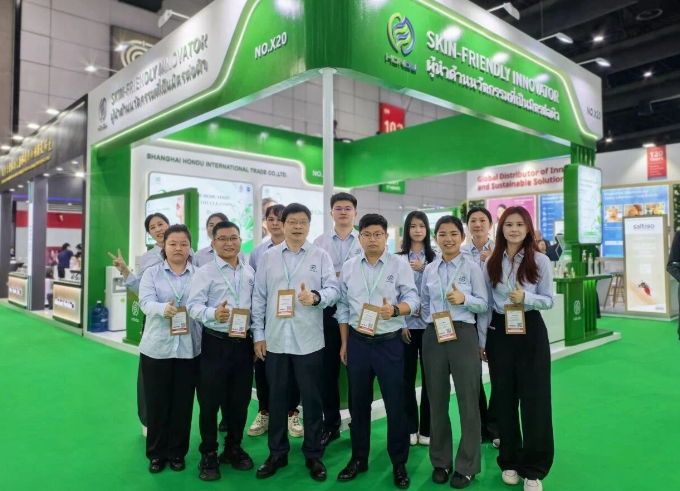
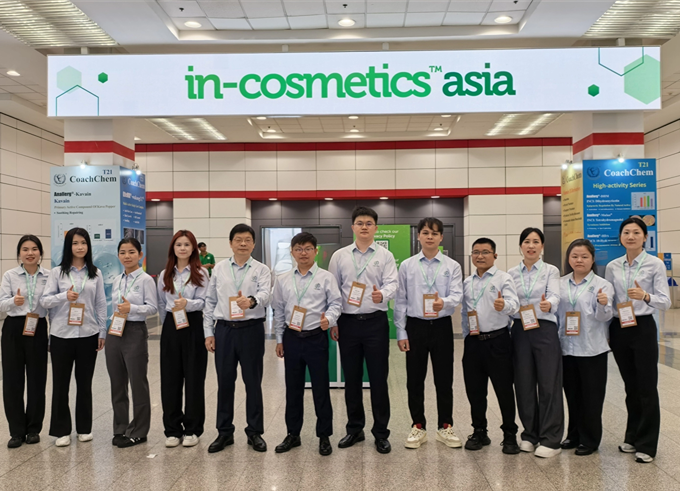
In-cosmetics Asia 2026
Bitec,bangkok,Thailand
X20

2027 PCHI
China Import and Export Fair Complex, Guangzhou, China
2L25